Check out this video:
This single features a star-studded ensemble (Beck, Sum 41, The Arcade Fire) known as the NORTH AMERICAN HALLOWEEN PREVENTION INITIATIVE. Both a trick and a treat, this song is a satire - as well as a charity-benefit song with all proceeds being donated to UNICEF.
Tuesday, October 31, 2006


Monday, October 30, 2006
YouTube Removes Comedy Central Clips Due to DMCA
Read this on Slashdot:
Today, YouTube removed all of its Comedy Central content. Google knew this was coming but you have to wonder if YouTube will be worth that $1.65 billion on Monday. The take down request comes a year after a Wired interview where Daily Show Executive Ben Karlin encouraged viewers to download: "If people want to take the show in various forms, I'd say go."
Now the video clip in one of my earlier posts about damn spammers doesn't play. Oh well. It was pretty humorous. Sorry if you missed it.
Today, YouTube removed all of its Comedy Central content. Google knew this was coming but you have to wonder if YouTube will be worth that $1.65 billion on Monday. The take down request comes a year after a Wired interview where Daily Show Executive Ben Karlin encouraged viewers to download: "If people want to take the show in various forms, I'd say go."
Now the video clip in one of my earlier posts about damn spammers doesn't play. Oh well. It was pretty humorous. Sorry if you missed it.
Halloween SongSpot
Halloween is tomorrow, so this week's SongSpot is from the band Erplosis Daet and it is called "Scary Halloween Monsters" from their album 'A Skip In The Brain'.
Thursday, October 26, 2006
All About Sound, Part 7
Another installment!! This is the latest installment of Scott Janus' "Audio in the 21st Century" from Audio DesignLine. Part 7 talks about measuring sound intensity and power.
In this article, he covers the basic math computations using the logarithmic scale and decibels. He briefly mentions that human hearing is not linear -- we can hear slight changes at low levels, but don't notice similar differences at high volumes. I think he plans to discuss this topic in more detail in a later installment.
In case he doesn't mention this... I thought I would go ahead and offer a little more detail. As mentioned in earlier installments, sound is created when something strikes another object. So when a guitar string vibrates, it is striking against air molecules. The vibrations cause the air nearby to compress and expand. A shorter string vibrates at a faster rate than a longer string, creating a higher pitched sound... The more compressed (or expanded), the more energy it contains and can expend. The loudness, or intensity of the sound is measured in terms of the amount of energy passing each second through one square centimeter of area. Energy expended over time is power and the unit is the watt. A watt is one joule per second. As you know, a 75 watt light bulb is pretty bright. A 40 watt bulb, not so bright. One of those small little night lights used to find the bathroom without bumping into a wall is probably around 1/4 watt. The amount of power found in sound is really small. The amount of power carried by ordinary conversational sound is about 1/1000 watt.
The human ear detects the difference in loudness by ratios of the power, not the actual differences. So, a 2000 microwatt (1/2000 watt) sound will seem louder than a 1000 microwatt sound, but a 3000 microwatt sound will not seem to sound louder by as much again. It actually takes a 4000 microwatt sound to seem louder by as much as a 2000 microwatt sound compares to a 1000 microwatt sound. To get a sound that is as much louder again than a 4000 microwatt sound, we would need an 8000 microwatt sound. The rations 2000/1000, 4000/2000, and 8000/4000 are all equal even though the difference are not, and it is the ratios that the ear detects.
This is where he explains that we don't hear linearly, but on a logarithmic scale. When one sound carries 10 times the power of a second sound, the ratio of the first to the second is 10 and the log (base 10) of this is 1. The difference in sound power is then said to be one 'Bel'. If a sound is 100 times more powerful than another sound, it is two Bels louder, 1000 times would be 3 Bels, etc. Since the Bel is too large of a scale for practical use, we use the decibel, which is 1/10th a Bel. A sound is a decibel louder than another when the first is 1.26 times as powerful as the second -- log(1.26) is about equal to 0.10.
The decibel is used one of two ways:
When dealing with these ratios, they use a standard reference for the denominator. For sound power or intensity, the denominator is the threshold of hearing (about the sound of a mosquito flying about 3 meters away), which is about 10-12 watts/m2. Sound pressure level (SPL) is usually used to specify the sound intensity. The upper limit of sound, before it behaves like a shock wave is about 194 dB (SPL). For comparison, windows break at about 163 dB; the sound of a jet engine from 30 meters (100 feet) is about 150 dB; the threshold of pain is about 130 dB; the sound of a train horn from 1 meter is about 120 dB and at this level can cause immediate perforation of your ear drum (so don't stand too close to a train when the horn goes off); and, loud music in a dance club is probably at 100 dB. They say anything above 85 dB is considered harmful and over 95 dB for long periods is considered unsafe.
BTW, so far, no one has entered the contest. I wonder why...? Is it the award -- no one likes beer or cheese? If so, any recommendations for a more enticing award? Is it because no one likes taking tests? Oh come on, it should be easy. All you have to do is read the articles. Is it because no one is reading those articles? (I know, I know, not many people are even reading this blog, so I'd really like to come up with useful info that potential readers find interesting). I'd really like some feedback on this. If there is a response, I might go ahead and post another test covering the later installments and award the winner with something like a gift certificate from Amazon.
In this article, he covers the basic math computations using the logarithmic scale and decibels. He briefly mentions that human hearing is not linear -- we can hear slight changes at low levels, but don't notice similar differences at high volumes. I think he plans to discuss this topic in more detail in a later installment.
In case he doesn't mention this... I thought I would go ahead and offer a little more detail. As mentioned in earlier installments, sound is created when something strikes another object. So when a guitar string vibrates, it is striking against air molecules. The vibrations cause the air nearby to compress and expand. A shorter string vibrates at a faster rate than a longer string, creating a higher pitched sound... The more compressed (or expanded), the more energy it contains and can expend. The loudness, or intensity of the sound is measured in terms of the amount of energy passing each second through one square centimeter of area. Energy expended over time is power and the unit is the watt. A watt is one joule per second. As you know, a 75 watt light bulb is pretty bright. A 40 watt bulb, not so bright. One of those small little night lights used to find the bathroom without bumping into a wall is probably around 1/4 watt. The amount of power found in sound is really small. The amount of power carried by ordinary conversational sound is about 1/1000 watt.
The human ear detects the difference in loudness by ratios of the power, not the actual differences. So, a 2000 microwatt (1/2000 watt) sound will seem louder than a 1000 microwatt sound, but a 3000 microwatt sound will not seem to sound louder by as much again. It actually takes a 4000 microwatt sound to seem louder by as much as a 2000 microwatt sound compares to a 1000 microwatt sound. To get a sound that is as much louder again than a 4000 microwatt sound, we would need an 8000 microwatt sound. The rations 2000/1000, 4000/2000, and 8000/4000 are all equal even though the difference are not, and it is the ratios that the ear detects.
This is where he explains that we don't hear linearly, but on a logarithmic scale. When one sound carries 10 times the power of a second sound, the ratio of the first to the second is 10 and the log (base 10) of this is 1. The difference in sound power is then said to be one 'Bel'. If a sound is 100 times more powerful than another sound, it is two Bels louder, 1000 times would be 3 Bels, etc. Since the Bel is too large of a scale for practical use, we use the decibel, which is 1/10th a Bel. A sound is a decibel louder than another when the first is 1.26 times as powerful as the second -- log(1.26) is about equal to 0.10.
The decibel is used one of two ways:
- to measure power or intensity
- to measure amplitude
When dealing with these ratios, they use a standard reference for the denominator. For sound power or intensity, the denominator is the threshold of hearing (about the sound of a mosquito flying about 3 meters away), which is about 10-12 watts/m2. Sound pressure level (SPL) is usually used to specify the sound intensity. The upper limit of sound, before it behaves like a shock wave is about 194 dB (SPL). For comparison, windows break at about 163 dB; the sound of a jet engine from 30 meters (100 feet) is about 150 dB; the threshold of pain is about 130 dB; the sound of a train horn from 1 meter is about 120 dB and at this level can cause immediate perforation of your ear drum (so don't stand too close to a train when the horn goes off); and, loud music in a dance club is probably at 100 dB. They say anything above 85 dB is considered harmful and over 95 dB for long periods is considered unsafe.
BTW, so far, no one has entered the contest. I wonder why...? Is it the award -- no one likes beer or cheese? If so, any recommendations for a more enticing award? Is it because no one likes taking tests? Oh come on, it should be easy. All you have to do is read the articles. Is it because no one is reading those articles? (I know, I know, not many people are even reading this blog, so I'd really like to come up with useful info that potential readers find interesting). I'd really like some feedback on this. If there is a response, I might go ahead and post another test covering the later installments and award the winner with something like a gift certificate from Amazon.
Tuesday, October 24, 2006
Testing 1, 2, 3... (Parts 1 - 4)
Okay, I've decided to post the sound test after all. Actually this only covers the first 4 parts and depending how this goes, I may post another one covering later installments. I'm really curious to see how many people are actually reading those articles. The person with the highest score will win a prize. If more than one person has the highest score, I will put their names in a hat and draw a winner. The winner will get to choose between a six-pack of Wisconsin micro-brewed beer or a pound of premium award winning Wisconsin cheese (or maybe I could be convinced to substitute something of equal value). At the end of the test, we have instructions for submitting your answers.
Here's the test:
To qualify for entry into this "contest", you must leave a comment to this post with some way to identify yourself -- maybe leave a nickname and your location. DO NOT INCLUDE YOUR ANSWERS IN YOUR COMMENT. Then submit your answers to soundtest1@amplioaudio.com. Be sure to include the same nickname identified in the exam's comments. The winner will be announced next Tuesday (Halloween), so you can submit answers until Monday night, which is October 30th.
Here's the test:
- True or False, sound requires a medium through which to propagate; sound does not travel through a vacuum.
- True or false, the speed of sound is faster at lower temperatures.
- Airborne sound travels in the form of:
- Latitudinal waves
- Awesome waves
- Transverse waves
- Longitudinal waves
- Attitudinal waves
- In the early evening when the air closer to the ground is still warm and the air higher in the sky is cool, sound waves will:
- Continue moving straight
- Reflect off the cooler air
- True or False, sound waves consist of alternating regions of compression (increased pressure) and rarefaction (decreased pressure). There is also an ambient pressure before the wave propagates.
- True or False, a pure tone is a sound with sinusoidal time fluctuations.
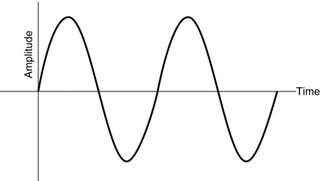
- The above figure represents a pure tone waveform. True or False, a period (T) is the time it takes for the wave to go from the highest amplitude to the lowest amplitude.
- True or false, in general, all sounds move at the same speed within the same medium.
- Given a pure tone with a period of 1 ms, what is the frequency of the tone?
- If a tree falls in the forest, does it make a sound?
- True or false, phase can be used to compare the alignment of two tones of the same frequency. This difference between two tones is known as a phase offset or phase difference. Phase offset is also loosely referred to as simply phase.
- Two pure tones with a frequency of 1000 hertz are 90 degrees out of phase. What is their phase offset in units of time?
- What is a convenient way to diagram how sound moves?
- Bubble diagrams
- Wave fronts
- Sound rays
- Both a and c
- Both b and c
- Since c (speed of sound) = f (frequency) multiplied times λ (wavelength); what is the wavelength of a pure tone with a frequency of 1500 hertz at STP (standard temperature and pressure)?
- True or false, the angles a sound wave hits and reflects off a smooth surface are the same.
- When two waves have a non-zero phase offset, they are said to be in phase. When two waves have zero phase offset, they are out of phase.
- True or false, when a sound wave refracts through another material with a higher speed of sound, the wavelength of the sound wave will decrease.
- True or false, the frequency (f) is the rate at which the wave repeats (cycles per second, called hertz).

To qualify for entry into this "contest", you must leave a comment to this post with some way to identify yourself -- maybe leave a nickname and your location. DO NOT INCLUDE YOUR ANSWERS IN YOUR COMMENT. Then submit your answers to soundtest1@amplioaudio.com. Be sure to include the same nickname identified in the exam's comments. The winner will be announced next Tuesday (Halloween), so you can submit answers until Monday night, which is October 30th.
All About Sound, Part 6
There's more!! They should just post the whole darn book. Here's the latest installment of Scott Janus' "Audio in the 21st Century" from Audio DesignLine. Part 6 discusses the doppler effect.
I think I'm going to postpone the test because I'd like to post it after all installments are posted at DesignLine. BTW, the highest score will get their choice of either a six-pack of wonderful Wisconsin micro-brewed beer or a block of premium cheese.
I think I'm going to postpone the test because I'd like to post it after all installments are posted at DesignLine. BTW, the highest score will get their choice of either a six-pack of wonderful Wisconsin micro-brewed beer or a block of premium cheese.
Monday, October 23, 2006
All About Sound, Part 5
Another installment of Scott Janus' "Audio in the 21st Century" from Audio DesignLine.
Part 5 is getting a little more technical, so pay attention. Oh, and don't forget about tomorrow's test.
Part 5 is getting a little more technical, so pay attention. Oh, and don't forget about tomorrow's test.
New SongSpot from Roxword
This weeks selection for our SongSpot is from Roxword. He's an old friend of mine and his real name is Steve Roxborough. Steve is a poet who lives in the state of Washington in a small town on an island on Puget Sound. We were college teammates and roommates (along with 6 other guys) many years ago. Steve brings us the latest in spoken word featuring a variety of musical and intellectual directions, moving seamlessly from R&B to jazz to rock to classical to soundscape to new age to music beyond category, all expertly punctuated with mind-bending poetry. This song is named 'Another Roadside Attraction' and is from his album Spiritual Demons.
Friday, October 20, 2006
Open Architecture
In previous posts I've mentioned that we'd really like to design a product that has the modularity and flexibility of the personal computer. Not the closed or proprietary architecture of the Mac, but the open architecture of the PC. Then people could choose the amp modules, power supplies, case, audio interface (soundcard), etc., that would meet their needs for number of channels, sound quality and budget.
From Wikipedia:
What do you think? As a consumer, would you like to purchase a system that could be expanded from 2 channels to 8 channels? Or upgrade the DACs or amplifier modules when a new generation is released? Be able to choose from a variety of case manufacturers to have one that best fits your style?
If there are any reps from manufacturers of amplifier modules, power supplies (the best technology for this would be switching power supplies or SMPS), or sound cards reading this, I'd love to hear what you think about this idea? Do you think it would expand your market, or not? Do you think the technical hurdles for designing your components to meet a specific form factor and use of standard connectors would be too limiting? Maybe someone like Creative would offer a version of their X-Fi that would be compatible -- and like the "Intel Inside" promo, they could have "X-Fi" inside. Of course, we could also have "UCD powered", etc.
From Wikipedia:
"Open architecture is a type of computer architecture that allows users to upgrade their hardware in all of the computer hardware & components (for example the IBM PC had an open architecture). This is the opposite of a closed architecture, where the hardware manufacturer chooses the components, and they are not generally upgradable (for example the Amiga 500 home computer had a closed architecture).
Open architecture allows potential users to see inside all or parts of the architecture without any proprietary constraints. Typically, an open architecture publishes all or parts of its architecture that the developer or integrator wants to share. The open business processes involved with an open architecture may require some license agreements between entities sharing the architecture information."
I'm not sure if we will ever be able to do this, but it is something I am interested in achieving. I think there is great potential here. It may even turn part of the consumer electronics industry upside down or inside out. Of course, this may not appeal to the ultra expensive, high end, "audiophile" producers and consumers, but I think it would really be great for the rest of us.What do you think? As a consumer, would you like to purchase a system that could be expanded from 2 channels to 8 channels? Or upgrade the DACs or amplifier modules when a new generation is released? Be able to choose from a variety of case manufacturers to have one that best fits your style?
If there are any reps from manufacturers of amplifier modules, power supplies (the best technology for this would be switching power supplies or SMPS), or sound cards reading this, I'd love to hear what you think about this idea? Do you think it would expand your market, or not? Do you think the technical hurdles for designing your components to meet a specific form factor and use of standard connectors would be too limiting? Maybe someone like Creative would offer a version of their X-Fi that would be compatible -- and like the "Intel Inside" promo, they could have "X-Fi" inside. Of course, we could also have "UCD powered", etc.
Subscribe to:
Posts (Atom)
